zorro

zorro
looking for the true

Sunday, July 8, 2012

Epic World History: "Cogito ergo sum" ~ René Descartes

Epic World History: René Descartes: René Descartes René Descartes was a metaphysician, mathematician, and natural philosopher responsible for changing the course of philoso...
              Art Spy: Expanding the world into first global age..

René Descartes ~ "Cogito ergo sum.."


René Descartes (French: [ʁəne dekaʁt]; Latinized form: Renatus Cartesius; adjectival form: "Cartesian"; March 1596 – 11 February 1650) was a French philosopher, mathematician, and writer who spent most of his adult life in the Dutch Republic. He has been dubbed the 'Father of Modern Philosophy', and much subsequent Western philosophy is a response to his writings,which are studied closely to this day..


***He is perhaps best known for the philosophical statement "Cogito ergo sum" (French: Je pense, donc je suis; English: I think, therefore I am), found in part IV of Discourse on the Method (1637 – written in French but with inclusion of "Cogito ergo sum") and §7 of part I of Principles of Philosophy (1644 – written in Latin).
For Descartes, morals was a science, the highest and most perfect of them, and like the rest of sciences had its roots in Metaphysics. In this way he argues for the existence of God, investigates the place of men in nature, formulates the theory of mind-body dualism and defends free will..
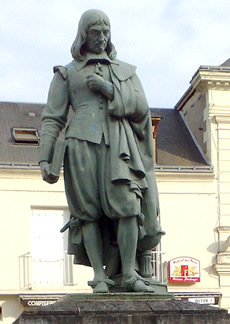
  "..By the 1640s, Descartes ran into trouble in the Dutch Republic where Cartesianism had won an extensive and vociferous following. Intellectually conservative, university-based Aristotelian Calvinists identified Cartesianism with their liberal Protestant enemies.. Although Descartes was not a courtier by nature and was quite concerned in his career to avoid patronage, he eventually succumbed to the lure of the court, and went to Stockholm in 1649 to tutor the brilliant young Queen Christina Vasa of Sweden (1626–89) in philosophy.."

You might also like from "Epic World History":
Pre-Socratic Philosophy

"..The pre-Socratics were Greek philosophers who speculated about the nature of the world for more than 150 years before Socrates flourished. Their philosophizing about nature sought answers to questions that were metaphysical and scientific, although these disciples were not then separated. The metaphysical questions asked by the pre-Socratics were inquiries into the ultimate nature of everything..
Their questions included What is the beginning (arche) or source of all things? What is reality and what is only appearance? What is everything made of?.."
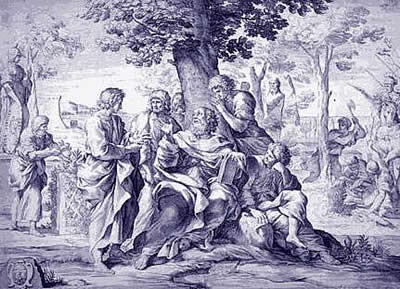


Socrates:

"..Socrates is one of the three greatest philosophers of Greek classical thought and, together with Aristotle and Plato, helped to provide the foundations of Western thought. Socrates was the first of this triumvirate, although he did not produce any written records of his beliefs.. He was brought to trial and condemned to death. 

However, the Socratic idea that it is possible to lead the mind to profound truths without previous knowledge of the background to those truths is no longer widely supported in academic institutions. Instead the Western tradition features the mastery of content as well as the ability to guide the mind to the truths behind or beyond that content.
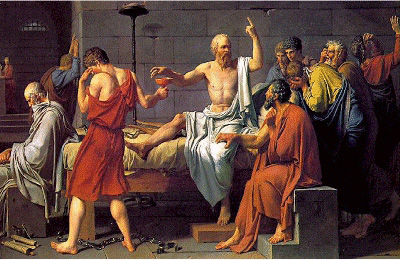


Socrates chose to swallow the hemlock that killed him even though it is likely that he could have escaped from confinement had he so desired. However, Socrates believed it was his duty to continue to serve the state and so acquiesced in the process..

However, the Socratic idea that it is possible to lead the mind to profound truths without previous knowledge of the background to those truths is no longer widely supported in academic institutions. Instead the Western tradition features the mastery of content as well as the ability to guide the mind to the truths behind or beyond that content.."

The Ancient World Prehistoric Eras to 600 c.e.

"..The deposition of the last emperor, Romulus Augustulus, in 476 c.e. by the Gothic chief Odovacar marks the fall of the Western Roman Empire and the subsequent transition from classic antiquity to the Middle Ages..
.. Chroniclers and laypeople alike had been far more traumatized by the Roman defeat at Adrianople (near Istanbul) in 378 c.e. in the East, the worst since Cannae, when Hannibal seriously threatened to overrun Rome, or by the Sack of Rome in 410 c.e. in the West.. In 378 the Goths destroyed the entire eastern Roman army at Adrianople, and emperor Valens fell on the battlefield. His successor, Theodosius I, was the last great emperor to rule over the whole of the empire..

There  ..was a last, short-lived attempt to reunify the Roman Empire. After Justinian’s death the eastern Byzantine Empire, which for a century continued to claim sovereignty over the West, although to no avail, became increasingly Hellenized and greatly influenced the development of eastern European cultures, while barbarian and western Romans lay the foundations of western European civilization..


Shared by Cintra Pirata "What News Pussycats" ~ aloha oe*


http://www.youtube.com/my_history?feature=mh_lolz

mrzotyi41.blogspot.hu
~ mrzotyi.blog.se
 "Art Spy" ~ aloha oe* 
~ funny stories in an eternal world ~
                                                                     

Top Ten Historical Sites in the World ~ aloha oe

Történelem mindenkinek ~ interesting parts of Human History ~

   http://mrzotyi41.blogspot.hu/ ~ cogito ergo sum ~

Epic World History: Edo Period in Japan

Epic World History: Edo Period in Japan: Edo Period in Japan The Edo period in Japanese dates between 1600 and 1867. It denotes the government of the Tokugawa Shogunate from Ed...

Epic World History: Johann Maier von Eck

Epic World History: Johann Maier von Eck: Johann Maier von Eck Johann Eck is best remembered for his debates with Martin Luther during the initial period of the Reformation. He ...

Epic World History: Dutch East India Company (Indonesia/Batavia)

Epic World History: Dutch East India Company (Indonesia/Batavia): Dutch East India Company (Indonesia/Batavia) The Verenigde Oostindische Compagnie (VOC) is better known in English as the Dutch East In...

https://mail.google.com/mail/u/0/?shva=1#inbox/1385a13aed8dfc47

Epic World History: Hernán Cortés - Spanish Conqueror

Epic World History: Hernán Cortés - Spanish Conqueror: Hernán Cortés - Spanish Conqueror Famed for his ruthlessly brilliant leadership in the Spanish conquest of Mexico, Hernán Cortés (Hernan...

Epic World History: Bartolomeu Dias - Portuguese Explorer

Epic World History: Bartolomeu Dias - Portuguese Explorer: Bartolomeu Dias - Portuguese Explorer Bartolomeu Dias, sometimes spelled Bartholomew Diaz, was an explorer for the Portuguese. He is bes...

https://mail.google.com/mail/u/0/?shva=1#inbox/138645a3eb3cca39

Friday, July 6, 2012

en Mosaic: Lindsay Dee Lohan Hot Babes

en Mosaic: Lindsay Dee Lohan Hot Babes: en mosaic - Lindsay Dee Lohan Hot Babes . This mosaic provided for informational purposes only and share your mosaic knowlegde about Lind...

Monday, July 2, 2012

What news pussy cats: REMEDIA AMORIS - cutie story how Ovid gives advice...

What news pussy cats: REMEDIA AMORIS - cutie story how Ovid gives advice...: REMEDIA AMORIS   -  cutie story how Ovid gives advices "how to avoid to falling in love" /here translated to spanish/ Re...


REMEDIA AMORIS ~ /here translated to spanish/
- cutie story how Ovid gives advices "how to avoid to falling in love"

https://plus.google.com/103841528573393883073/posts/daoXh184sFw
https://plus.google.com/103841528573393883073/posts/daoXh184sFw  

Tommy Ritterland http://www.youtube.com/watch?v=x2s7oJAw9I8 ♥


 recitado en español ~ www.youtube.com


La obra es un manual para ayudar a los amantes desgraciados a recuperarse de las...

 OVIDIUS: "..CURES FOR LOVE.." 

"..The Love Books.." of Ovid.. 

Publius Ovidius Naso (March 20, 43 BC – 17 AD) was a Roman poet known to the English-speaking world as Ovid who wrote on many topics, including love, abandoned women and mythological transformations. Ranked alongside Virgil and Horace as one of the three canonical poets of Latin literature, Ovid was generally considered a great master of the elegiac couplet. His poetry, much imitated during Late A...more

Works:  Amores ("The Loves")


Engraved frontispiece of George Sandys’s 1632 London edition of Ovid's Metamorphoses Englished.
The Metamorphoses, Ovid's most ambitious and popular work, consists of a 15-book catalogue written in dactylic hexameter about the transformations in Greek and Roman mythology set within a loose mytho-historical framework.. 

L'Idylle, by William Bouguereau [1850] (Public Domain Image)  Sisyphus - (Greek legend) a king in ancient Greece who offended Zeus and whose punishment was to roll a huge boulder to the top of a steep hill

Tristia ("Sorrows")

The Tristia consist of five books of elegiac poetry composed by Ovid in exile in Tomis. Book 1 contains 11 poems; the first piece is an address by Ovid to his book about how it should act when it arrives in Rome. 3 describes his final night in Rome..  


To leave ♥  your partner:

  • Trying to quit loving before the feeling becomes too important
  • Trying to be as busy as you can, e.g. with work
  • Traveling and trying to avoid familiar places that remind you of your relationship
  • Having many affairs, or at least another affair to forget the previous one
  • Trying to have sex in an unpleasant way
  • Focusing on the unpleasant body parts/physical flaws of the partner
  • Trying to focus on all unfortunate things that happen because of the relationship, such as material issues
  • Avoiding staying by yourself
  • Avoiding places where you can see couples..


Lost works:

REMEDIA AMORIS ♥ ♥ ♥ 

- cutie story how Ovid gives advices "how to avoid to falling in love"..
 (Love's Remedy or The Cure for Love)

One loss which Ovid himself informs us of is the first five-book edition of the Amores from which nothing has come down to us. The greatest loss is Ovid's only tragedy, Medea, from which only a few lines are preserved.. 

Fénykép


PUBLIUS OVIDIUS NASO
(Kr. e. 43—Kr. u. 17)
 
  
In the Amores, published about 18 BCE, Ovid portrays the evolution of an affair with a married woman named Corinna. It is unclear as to whether this is fictional or autobiographical, but it is obviously based on the experiences of a sophisticated lover. The Ars Amatoria, published about 1 BCE, is a guidebook for seduction; it includes many tips and tricks which would not be out of place in a modern dating manual, while giving intimate vignettes of daily life in Ancient Rome. The first two books are written from a male point of view; the last book, which was probably written at a later date, is addressed to women. It is believed that this work, which celebrates extramarital sex, was one of the reasons that Ovid was banished by the Emperor Augustus, who was attempting to promote a more austere morality..
 
In spanish: La obra es un manual para ayudar a los amantes desgraciados a recuperarse de las...See More
     
     "Art Spy" ~ aloha oe*    


*** Create funny pictures with your photos on enjoypic  

Sunday, July 1, 2012

Age Mythology Stories: The Kschinas are Coming

Age Mythology Stories: The Kschinas are Coming: When the world was still new, before large game animals had come to the Hopi people, mice were the only source of meat. But trapping mice to...

Saturday, June 30, 2012

Rudolf II, Holy Roman Emperor by Cintra Pirata ~ aloha oe*

Rudolf II, Holy Roman Emperor


Rudolf II, Holy Roman Emperor for instance was the subject of a whispering campaign by his enemies in his family. He was more intrigued by occult learning such as astrology and alchemy, which was mainstream in the Renaissance period. He suffered from periodic bouts of "melancholy" (depression), which was common in the Habsburg line. These became worse with age. Rudolf is also the ruler in many of the legends of the Golem of Prague..At least he was left all alone ~ and in the night time he used to walk around in his castle in company of an old toothles lion..


Rudolf died three days after the death of his favorite lion, on January 20, 1612. In his final hours of life, he rejected the sacraments like his father, Maximilian II.
Rudolf collected clocks, and had a passion for plants and animals. He loved his lion, which was a gift from the Sultan of Turkey. The lion was an ancient symbol of rank and power. The lion was one of the oldest symbols of the Bohemian Kings, as Holy Roman Emperors..
..In his calm state, Rudolf was described as "measured and reasonable." He was well-informed and curious. He spoke German, Spanish, Italian, Latin, and French. He understood Czech. He was enigmatic and could be generous and humane. However, he was rather disappointed with the world in general..

RUDOLF'S SCIENTIFIC HEROES AND COURTIER'S WERE:

  • Tycho Brahe - astronomer and Danish alchemist from a noble family.
  • Johannes Kepler - astronomer. Johannes mother was persecuted as a witch. Kepler died November 15, 1630 in Regensburg. He was a professional astronomer to General Albrecht von Wallenstein, Duke of Friedland and Meckleburg, in the Duchy of Sagan.
  • Jakub Krocinek - astrologer. Jakub had two sons, the youngest son killed his own brother.
  • Trithemius - a Benedictine monk who was into "natural magic."
  • Parcelsus - an alchemist and physician. Parcelsus was also known as Theophrastus Bombastus von Hohenheim (his real name).
  • Henry Cornelius Agrippa - sought occult knowledge. He was a Neoplatonist and alchemist.
  • Guiseppe Arcimboldo - painter
  • Bartholomaeus Spranger - painter
  • John Dee - occult philosopher
  • Ramon Lull - Christian mystic
  • Giordano Bruno - occult philosopher and magician.
  • Albertus Magnus - alchemist who practiced "white magic."
  • Dr. Tadeas Hajel (Thaddeus Hagecius) was from Prague. He was a master of ars magica and occult philosophy.
  • Roger Bacon - alchemist. "Blue magic" referred to necromancers or witches. Many of the men above were accused of these and had to beware of the Inquisitors.


Occult sciences:


Rudolf II was a curious man. He had frequent bouts of insanity which allowed the structure of his government to be undermined. More and more of the Holy Roman Empire’s work was taken on by Matthias, the third brother of Rudolf, though he had not been given permission to do this by Rudolf. By 1600, the Habsburg Court seemed to be on the verge of breaking up under the strain of having an emperor who could not govern combined with a man who did not have a remit to rule..

The German princes tried to take advantage of this problem but in 1600 rather than combine their efforts, they were split amongst themselves...


Astrology and alchemy were mainstream science in Renaissance Prague, and Rudolf was a firm devotee of both. His lifelong quest was to find the Philosopher's Stone and Rudolf spared no expense in bringing Europe's best alchemists to court, such as Edward Kelley and John Dee. Rudolf even performed his own experiments in a private alchemy laboratory.[2] When Rudolf was a prince, Nostradamus prepared a horoscope which was dedicated to him as 'Prince and King'..

 *** Rudolf had a very well-stocked library, which was touted as one of the best in Europe. Nostradamus cast Rudolf's birth chart, as did Dee and others. He always wanted to know his fate and was always thinking his death would come in a rare fashion..

Rudolf gave Prague a mystical reputation that persists in part to this day, with Alchemists' Alley on the grounds of Prague Castle a popular visiting place.
Rudolf is also the ruler in many of the legends of the Golem of Prague, either because of or simply adding to his occult reputation..

 Wappen Kaisertum Österreich 1815 (Klein).png


  ***The Holy Roman Empire was potentially Europe’s greatest state. However, by 1600 the Holy Roman Empire was a mere shadow of its former glory. The heart of the Holy Roman Empire had been Germany. But by 1600, a better term for the area would have been "Germanies" as the heart of the Holy Roman Empire had become split into a mass of princes and states ...

More info//